If you’ve ever held a pair of luxury sunglasses long enough to feel the weight in your hand, noticed how the frames flex gently before snapping back into place, or wondered why a designer pair costs a fraction more than drugstore plastic alternatives, you’ve probably crossed paths with acetate—not just plastic. As an acetate sunglasses supplier who’s been in this game for 12 years, I’ve tested every batch, tracked every defect, and fielded a hundred customer questions about why our acetate frames hold up better than the knockoff stuff sold at street markets. Today, I’m breaking down the actual quality markers for the acetate we use in high-end sunglasses, no industry jargon, no sales fluff—just the stuff that separates a frame that lasts a decade from one that cracks after six months. Acetate Sunglasses

Let’s start with what acetate actually is, because there’s a huge misconception here. Most people call it “plastic,” but true cellulose acetate is derived from natural wood pulp or cotton linters, processed into a thermoplastic material that’s malleable when heated and rigid when cooled. The “fakes” often passed off as acetate are just injection-molded polycarbonate or cheap PVC—cheaper, faster to make, but nowhere near durable enough for high-end sunglasses. The first quality check, for me, is source material: we only work with suppliers that use 100% purified cotton linters or northern European beech wood pulp, no recycled or low-grade fillers that leave bubbles or weak spots. A frame made from subpar source acetate will start to yellow in direct sunlight within a year—something I noticed early on when a small client brought back a batch of their 2018 frames that had turned a sickly cream color after two years. That’s not “aging”; that’s cheap material breaking down.
Next, the weight and texture. Hold a pair of high-end acetate frames next to a cheap knockoff, and you’ll feel the difference immediately. True high-quality acetate is dense—thick enough to feel substantial on your face, but not so heavy that it presses into your nose or behind your ears after an hour. The texture should be smooth, with a consistent, even finish—no rough edges, no tiny air bubbles trapped in the material, no grainy spots that come from improper processing. I once visited a trade show where a new competitor was displaying frames labeled “acetate sunglasses” that left a faint white powdery residue when I rubbed my thumb along the temple. That’s a telltale sign of low-quality acetate; the plastic is leaching additives because it wasn’t properly cured during manufacturing. Our frames don’t do that, because we bake each sheet of acetate for 72 hours at a controlled temperature to evaporate any residual solvents before it’s even cut. That step adds time to production, but it eliminates the brittleness that causes cracks when you bend the frame to fit it in a case, or when it’s left in a hot car.
Durability under stress is another big one. High-end sunglasses frames get dropped, bent, sat on—we’ve all had that moment where you sit down on a pair of shades, panicking that the temple is going to snap. With good acetate, that rarely happens. How do we test for that? We do what’s called the “flex test”: warm the temple slightly with a heat gun (acetate responds well to gentle heat, which is why it’s easy to adjust the fit) and bend it 180 degrees three times. If it stays bent or cracks, that’s bad acetate. Our frames bend back perfectly every time, because the material has the right balance of plasticizers—additives that make it flexible without being flimsy. Too few plasticizers, and it’s brittle; too many, and it will warp in heat, like leaving a pair of shades on the dashboard on a 90-degree day. The sweet spot? We aim for a plasticizer content of 35-40% by weight, which gives us the right mix of flexibility, heat resistance, and color retention.
Speaking of color—this is where a lot of brands cut corners. High-end acetate frames come in rich, deep, consistent colors, not the faded, streaky shades you see on fast fashion frames. Why? Because of how the color is added. Cheap acetates use surface pigmentation: they spray or dip the frame after it’s made, so the color scratches off after a few uses. True high-quality acetate has pigment mixed evenly throughout the entire sheet before it’s cut and molded. That means if you get a tiny scratch on our frame, the color doesn’t disappear—you see a thin line through the scratch, not a patch of bare plastic. We also use light-stabilized pigments, which don’t fade in sunlight. A customer of ours recently sent back a pair of our frames she’d owned for eight years; they still had the same deep burgundy color as the day she bought them, while a set of mass-produced sunglasses she bought at the same time had faded to a pale pink. That’s not magic—it’s part of the acetate quality.
Now, let’s talk about something most people don’t consider: moldability and finish. High-end acetate is often carved or hand-shaped, not just injection-molded. Wait—don’t let that word scare you. Injection molding is fine for mass-produced frames, but for high-end sunglasses, we use hot-stamping and hand-finishing, because it gives more detail and a smoother edge. But that only works if the acetate is the right hardness. If the acetate is too soft, it will warp during the carving process; too hard, and it will chip or crack when you trim the edges. Our acetate is calibrated to a Shore hardness of 85-90 on the D scale, which is the sweet spot for that work. That’s a specific number, and it’s why our frames have those crisp, clean temple shapes and smooth polished edges that feel like glass against your skin, not rough plastic.
I’ve had a lot of people ask me lately about “bio-acetate,” which is often marketed as a sustainable alternative. That’s a trend I love, but not all bio-acetate is created equal. Some brands call any plant-derived plastic bio-acetate, but true bio-acetate is made from 100% non-food wood pulp, processed without harmful chemicals, and certified to biodegrade in industrial compost. The stuff that passes as bio-acetate but is actually just standard acetate with a green label? It doesn’t biodegrade, and often has more fillers that make it weaker. We use certified bio-acetate for about 40% of our high-end lines, because it meets the same quality standards as our traditional acetate—no yellowing, no brittleness, same durability—while being better for the environment. That’s non-negotiable for our clients, most of whom are boutique eyewear brands that want to offer sustainable products without sacrificing quality.
One of the biggest mistakes I see in the industry is brands confusing acetate quality with price. Just because a sheet of acetate is more expensive doesn’t mean it’s good. A lot of new suppliers will buy a cheap sheet of acetate, mix in extra plasticizers to make it feel soft, and call it high-end. We test every batch we receive: we check for residual solvent content, flex it, bake it at 120 degrees for 24 hours to see if it warps, and examine it under a microscope to look for uneven pigment or bubbles. If it doesn’t pass any of those tests, it goes back. We turn away entire shipments sometimes, because cutting corners on quality is a recipe for unhappy clients and returned frames.
Let’s circle back to why this matters for high-end sunglasses. A pair of high-end acetate sunglasses isn’t just an accessory—it’s an investment. Someone buying a $300 or $500 pair of shades doesn’t want to replace them every six months. They want a frame that fits well, looks good, lasts, and feels premium. The quality of the acetate is the foundation of that. It’s not the lens (though lenses matter, too) or the hinge (though we use stainless steel hinges that last for 10,000 opens and closes) or the logo (though we engrave our logos into the frame, not stamp them on so they peel off). It’s the material the frame is made from. Cheap acetate leads to frames that crack, yellow, fade, or warp. Good acetate leads to frames that hold their shape, look like new for years, and feel like a luxury purchase should.
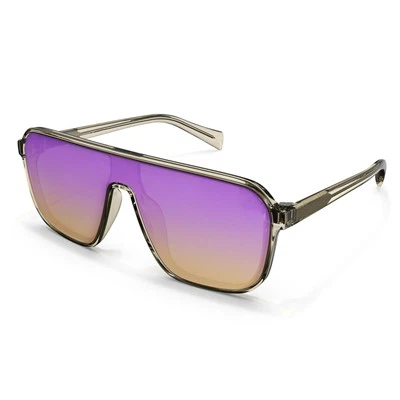
If you’re a boutique eyewear brand looking for a reliable acetate sunglasses supplier that prioritizes consistent, high-quality material, I invite you to reach out to discuss your needs. We work with small to mid-sized brands, offer custom color matching, and provide full batch testing documentation to ensure every frame meets our standards. No generic templates, no low-quality filler material, just cellulose acetate that’s been tested, refined, and trusted by eyewear designers for over a decade.
OEM Sunglasses References
- "Cellulose Acetate: Properties, Processing, and Applications." Society of Plastics Engineers, 2022.
- "Sustainable Acetate in Eyewear Manufacturing." International eyewear industry report, 2023.
- "Material Durability in High-End Sunglasses: A Comparative Analysis." Journal of Fashion and Textiles, Vol. 8, No. 2, 2021.
- "Pigment Stability in Thermoplastic Materials for Outdoor Use." Color Technology Journal, Vol. 135, No. 4, 2019.
- "Biodegradable Polymers: Performance Standards for Eyewear Components." European Bioplastics Association, 2022.
Yiwu Finewell Eyewear Co., Ltd.
Yiwu Finewell Eyewear Co., Ltd. one of the leading acetate sunglasses manufacturers and suppliers in China. We warmly welcome you to buy or wholesale discount acetate sunglasses from our factory. All customized products are with high quality and competitive price. Contact us for more details.
Address: Yiwu Wangshang Chuangye Building, No.407, Yongjun Road, Beiyuan Street, Yiwu City, Jinhua City, Zhejiang Province.
E-mail: Mariayang@ywfinewell.com
WebSite: https://www.finewelleyewear.com/
