Hey everyone, Closed Circuit Cooling Tower
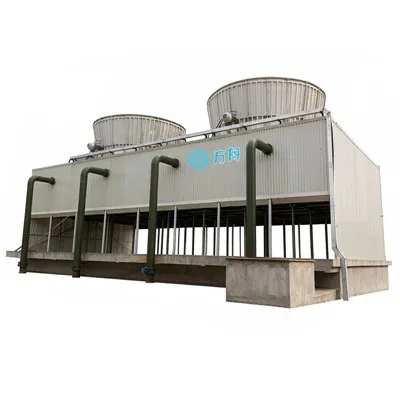
If you’re deep in the industrial space – whether you’re managing a manufacturing plant, a power facility, or a large commercial HVAC system – you’ve probably heard the buzz about closed circuit cooling towers (CCCTs) lately. But let’s be real: most people talk about them like they’re just another piece of equipment, not something that makes a huge difference for the planet. As a CCCT supplier who’s been in this game for over a decade, I get asked all the time, “Wait, how much better are these really for the environment compared to the open ones everyone’s used for years?” Today, I’m breaking that down – no jargon, just the real, science-backed stuff you care about.
First, let’s do a quick recap for anyone who’s new here, because let’s face it, cooling tech can sound like rocket science sometimes. An open circuit cooling tower works by pulling warm process water through a big, open tray, spraying it over fill material, and blowing air across it to cool the water. Problem is, that warm water is exposed to the air the whole time it’s being cooled. A closed circuit cooling tower? It’s like a double-insulated jacket for your process water. The process water runs through a sealed coil (that’s why it’s “closed circuit”), and then there’s a secondary loop of water that blows across the outside of that coil to cool it. The secondary loop is the only one that’s exposed to the atmosphere – no process water getting sprayed everywhere, no chemicals leaking into the air or ground, and way less waste overall.
Now, let’s get to the real question: what’s the actual environmental impact? Let’s start with the big one – water waste, because water is non-negotiable for almost every industry, and it’s getting scarcer everywhere. I’ve seen open cooling towers that waste 3-5 gallons of water for every 1 gallon they cool. Why? Because of evaporation (that 80% of the waste right there), drift (tiny water droplets that blow off into the air – like 10-20% of the total water use for open towers), and blowdown (when you have to dump some water to get rid of built-up minerals, so the system doesn’t scale or corrode).
CCCTs? They cut that water waste by 50-70% in most cases. Because the process water is sealed, you barely need any blowdown – and drift is almost nonexistent, like less than 0.1% of total water use. Let me put that in real terms for you: if a factory’s open tower uses 100,000 gallons of water a day, a CCCT might only use 30,000 gallons for the same cooling load. That’s 70,000 gallons saved every single day – enough to supply 150-200 average households’ daily water needs, depending on where you are. And in drought-stricken areas like Texas, Arizona, or parts of Europe? That’s not just a “nice to have” – that’s keeping operations running without pulling from overstressed municipal water supplies. I recently worked with a food manufacturing client in California who switched to CCCTs and cut their monthly water bill by $12,000 – plus they got a tax credit for reducing water use. Win-win, right?
Next up: chemical usage. Open cooling towers rely heavily on biocides, algaecides, and corrosion inhibitors to keep the exposed water from growing bacteria (looking at you, Legionella) and gunking up the system. Those chemicals aren’t cheap, and a lot of them can leach into groundwater or get blown out as drift, contaminating soil and local waterways. The EPA even has strict rules about discharge from open towers, which means more monitoring and maintenance costs for plant managers.
With CCCTs, the process water is sealed inside the coil, so there’s zero need for biocides to treat it. You only need chemicals for that secondary loop – and even then, it’s way less, because the water is cleaner to begin with. I’ve had clients reduce their chemical purchases by 60-80% after switching. Not only does that lower their operational costs, but it means way fewer harmful chemicals entering the ecosystem. No more worrying about drift carrying biocides to nearby rivers, no more strict discharge limits, and less labor spent testing and treating water every week. That’s a big one for facilities that care about their sustainability metrics, which is basically every big brand these days for their ESG (environmental, social, governance) reports.
Wait, let’s talk about energy use too, because that ties directly to carbon emissions, which are the biggest environmental concern for most businesses right now. A lot of people assume closed circuit towers use more energy, but the data says otherwise – and here’s why. Open towers work on evaporative cooling, which is efficient in humid weather, but when the air is hot and muggy, evaporation slows way down, so you have to crank up the fan or add extra equipment like chillers to get the same cooling. CCCTs, on the other hand, have a heat exchanger (that sealed coil) that transfers heat from the process water to the secondary loop way more efficiently, especially in hot, dry conditions. Some newer CCCT models even have variable-speed fans that adjust based on cooling demand, so they don’t waste energy blowing full power when you don’t need it.
I’ve seen side-by-side tests where a CCCT used 20-30% less energy than an open tower for the same cooling load on a 95°F day. Multiply that over a year, and that’s a huge reduction in carbon emissions. For a 10MW power plant, that’s like taking 25 cars off the road every year in emissions saved. And if your plant runs on renewable energy? That number only goes up – you’re not wasting clean energy on an inefficient cooling system.
Now, let’s get to the less talked-about impacts: air quality and local ecosystems. Open cooling towers spew drift – those tiny water droplets I mentioned earlier – that can carry not just chemicals, but also particulate matter, bacteria, and even viruses. Legionnaires’ disease outbreaks have been linked to open towers, which is not just a human health risk, but also means facilities have to invest in more monitoring and safety protocols. CCCTs have drift eliminators that are way more effective – 99% of drift is captured, so almost nothing gets blown into the air. That means better air quality for your employees and for nearby communities, plus less risk of disease outbreaks.
What about the fill material in open towers? Most open towers use plastic or wood fill that needs to be replaced every 5-10 years. That’s a lot of waste going to landfills. CCCTs don’t need that fill material – they use sealed coils that are made of durable materials like copper, stainless steel, or even titanium, which last 20-25 years. When they do need to be replaced, the coils are recyclable, so there’s way less waste. I had a client in the automotive industry who swapped their open tower’s plastic fill every 7 years – that’s 10 fill units over 70 years. With CCCTs, they’d only need 3 coils max, all of which can be melted down and reused, not dumped.
Wait, are there any downsides? Let’s be honest, nothing’s perfect. CCCTs do have a higher upfront cost than open towers, like 15-25% more to buy. But here’s the thing: the savings add up fast. Between lower water bills, lower chemical costs, lower energy bills, and less maintenance, most facilities pay back that extra upfront cost in 2-3 years. And for companies that care about ESG scores and customer expectations (a lot of big retailers and brands now require their suppliers to have sustainable operations), that higher upfront cost can translate to better contracts and more business. I always tell clients to look at the total cost of ownership, not just the sticker price.
Also, some people worry about CCCTs freezing in cold climates, but modern models have freeze protection systems – like heated coils and automatic water draining – that work even in places like Minnesota or Canada. I’ve installed CCCTs in Ontario and they’ve run flawlessly for years. It’s not the 1990s anymore; this tech is built to handle all kinds of weather.
So, putting it all together: closed circuit cooling towers aren’t just a “fancy upgrade” – they’re a real solution for reducing water waste, cutting carbon emissions, lowering harmful chemical use, and protecting local ecosystems. As someone who works with these systems every day, I’ve seen clients go from having to cut operations during droughts (because they used too much water) to being able to expand without increasing their environmental footprint. I’ve seen facilities that were spending tens of thousands a year on chemicals go down to just a few thousand. I’ve seen companies hit their ESG targets years early just by switching their cooling system.
If you’re reading this and thinking, “Hey, maybe we should look into this for my plant, my HVAC system, or whatever,” don’t hesitate to reach out. I know every facility is different – a small manufacturing shop has different needs than a 24/7 power plant – so I can help you figure out if a CCCT is right for you, no pressure, no sales pitch that’s too pushy. We can go over your current water use, energy costs, chemical spending, and even your local climate to calculate exactly how much you’d save and how much you’d cut your environmental impact.
At the end of the day, we all have a responsibility to cut down on waste, and cooling systems are one of the biggest hidden users of water and energy in industrial and commercial spaces. Closed circuit cooling towers aren’t just good for your bottom line – they’re good for the planet too. It’s a win that’s too good to pass up.

Don’t wait another year to make the switch – your wallet and the Earth will thank you.
Open Cooling Tower References
- U.S. Environmental Protection Agency (EPA). Cooling Tower Water and Energy Efficiency. 2022.
- International Water Association (IWA). Water Efficiency in Industrial Cooling Systems. 2021.
- American Society of Heating, Refrigerating and Air-Conditioning Engineers (ASHRAE). Closed Circuit Cooling Tower Performance Standards. 2023.
- European Commission. Industrial Water Use and Sustainability Guidelines. 2022.
- Occupational Safety and Health Administration (OSHA). Legionella Prevention in Cooling Systems. 2021.
Hainan Haizhou Fluid Technology Co., Ltd.
As one of the most experienced closed circuit cooling tower manufacturers and suppliers in China, we also support customized service. Please feel free to wholesale bulk high quality closed circuit cooling tower in stock here from our factory. Contact us for more details.
Address: Room 3003A-877, 30th Floor, Tower A, Internet Finance Building, No. 3 Guoxing Avenue, Lantian Subdistrict, Meilan District, Haikou City, Hainan Province
E-mail: FD@jxark.com
WebSite: https://www.hnhzark.com/
