As a supplier of electric stackers, I get this question all the time from warehouse managers, forklift operators, and maintenance teams: “Can electric stackers be repaired on-site?” It’s a fair question. When your stacker is down, even for a few hours, it can throw your entire warehouse workflow off. I’ve seen companies lose thousands in downtime because they waited for a technician to travel to their location, especially if their facility is in a remote industrial park or a part of the city with limited service access. After years of working with fleets of electric stackers, I can tell you the answer is almost always yes—but with a few important caveats. Electric Stackers
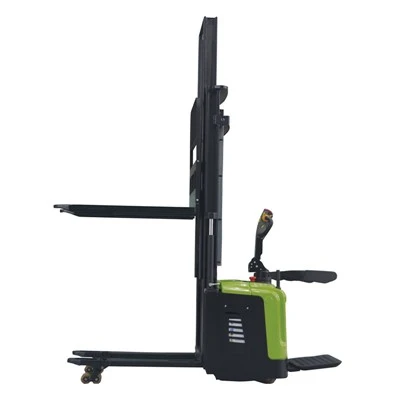
Let me start by breaking down what an on-site repair for an electric stacker actually involves. Unlike internal combustion (IC) forklifts, which have more moving parts that require specialized tools for things like engine overhauls, electric stackers are simpler machines. They run on batteries, electric motors, and control systems that are often compact enough for a trained technician to troubleshoot without needing to move the entire machine off the warehouse floor. For example, common issues like dead batteries (if it’s just a bad cell, not a total failure), faulty safety switches, or worn-out hydraulic hoses don’t require taking the stacker apart in a shop. A technician can grab a battery tester, a replacement switch, or a new hose, and fix it right where the stacker is parked.
But here’s the thing: not all repairs are suited for on-site work. If your electric stacker has a major issue like a damaged motor winding, a faulty main controller, or a problem with the lifting mechanism’s hydraulic pump, you might need to pull it into a shop. That’s because those repairs require more precise testing equipment and sometimes parts that are easier to work with in a controlled environment. From my experience, though, 70 to 80 percent of the issues our customers report are minor enough to handle on-site. I remember a customer last quarter in a manufacturing plant on the west side of the city—their stacker wouldn’t lift pallets, and they thought the whole machine was done. One of our service techs went to their location, checked the hydraulic fluid level first (something people forget to do all the time), and found a clogged filter. He swapped it out in 20 minutes, and the stacker was back to work. That’s the kind of on-site repair that saves businesses from costly delays.
A lot of warehouse managers also worry about the skill level required for on-site repairs. They don’t want to hire someone who’ll mess up the machine even more. From our standpoint, on-site repairs for electric stackers are best done by technicians who are factory-trained. That means they know the specific model of your stacker inside and out—they can read the error codes from the control panel, identify when a battery is holding a charge incorrectly, and know the right replacement parts to use. If you try to do it yourself with generic parts, you might end up causing more damage. For example, using a hydraulic hose that’s not rated for your stacker’s pressure can lead to leaks or even a blowout, which is a safety hazard.
Another point to consider is availability of parts. When a stacker breaks down, you don’t want to wait three days for a part to ship. As a supplier, we keep a large inventory of common replacement parts at local distribution centers, so our technicians can bring them to the job site. Things like safety switches, fuses, battery cells, and hydraulic filters are always in stock. For less common parts, we can usually get them overnight, and in most cases, a technician can install them on-site. If you had to tow the stacker to a shop, that downtime would add another day or two, which is why on-site repairs are so valuable.
I should also mention safety. Electric stackers are designed with a lot of safety features—like emergency stop buttons, overload protection, and auto-braking systems. When you’re repairing them on-site, you have to follow specific safety protocols to avoid accidents. Our technicians are trained to lock out the machine’s power before working on any electrical components, to use proper lifting equipment for heavy parts, and to test the machine thoroughly after repairs to make sure all safety features are working. That’s why it’s important to work with a supplier that offers on-site service—not just someone who sells the machines, but someone who knows how to keep them running safely.
Now, let’s talk about when on-site repair might not be the best option. If your stacker has been in a collision or has sustained major damage to the frame, that’s probably something that needs a shop repair. The same goes for battery packs that have been damaged—if the casing is cracked, you can’t repair that on-site because it poses a fire risk. Also, if your stacker is older, say 10 years or more, and has had multiple issues, it might be more cost-effective to replace it than to keep repairing it on-site. But that’s a conversation you should have with your supplier, not a rule that applies to all machines.
I’ve seen customers make the mistake of trying to cut corners on repairs. They’ll hire a general mechanic who doesn’t know electric stackers, and end up spending more money fixing the mistakes later. Or they’ll wait to call for service, letting a small issue turn into a major one. For example, a customer last year ignored a small hydraulic leak in their stacker, and a few weeks later, the pump burned out. That required a major repair, which took the stacker off the floor for three days. If they’d called for an on-site repair when the leak first started, it would have cost a fraction of the price and taken a fraction of the time.
As a supplier, our goal is to help our customers keep their electric stackers running as efficiently as possible. That’s why we offer on-site repair services for all the machines we sell. We know that downtime is expensive—for a warehouse that runs 24/7, even an hour of downtime can mean missing a shipping deadline, which can lead to lost revenue or even penalties with customers. On-site repairs eliminate that downtime, because we can fix the machine while it’s still in your facility, without having to move it.
Another benefit of on-site repair is that our technicians can do a preventive maintenance check at the same time. When they’re troubleshooting a small issue, they can look at other parts of the stacker—like the tires, the battery cables, and the safety features—to make sure everything is working as it should. That helps catch small problems before they turn into big ones, which saves you money in the long run. For example, a technician might notice that the brake pads are wearing down, and replace them during the same on-site visit, instead of having to come back later.
I want to make it clear that not all suppliers offer on-site repair. Some will sell you a stacker and then leave you to handle maintenance on your own. That’s a mistake. Electric stackers are complex machines, and they need regular care and timely repairs to last. As a supplier, we stand behind our products, which means we’re there for you when something goes wrong. We have a team of factory-trained technicians who cover the area, so no matter where your facility is, we can send someone out quickly.
Let me share a recent success story. A small distribution center in the suburbs had two electric stackers that were both having issues—one wouldn’t charge, and the other wouldn’t lift heavy pallets. They thought they’d have to rent a temporary stacker while waiting for a shop repair. But we sent two technicians to their site, and in four hours, they fixed both machines. The stacker that wouldn’t charge had a faulty charger (not the battery), and the one that wouldn’t lift had a worn-out sprocket. They didn’t have to rent any equipment, and they didn’t lose any time on their shipping schedule. That’s the kind of value that on-site repair provides.
Now, I know some people might be skeptical. They might think that on-site repair is more expensive than shop repair. But in most cases, it’s actually cheaper. Because you don’t have to pay for towing the machine, and you don’t lose revenue from downtime. When you add up the cost of downtime and towing, the price of on-site repair is often a better deal. Plus, our technicians are efficient—they know what they’re doing, so they can fix the problem quickly, without wasting time.
So, to answer the original question: Can electric stackers be repaired on-site? Yes, in most cases. But it depends on the type of repair, the age of the machine, and whether you’re working with a qualified technician. If you’re having issues with your electric stacker, don’t assume you have to tow it to a shop. Call your supplier first—they can send a technician to your site to diagnose the problem and fix it on the spot.
If you’re having trouble with your electric stacker’s repair, or if you’re looking to invest in a new electric stacker for your warehouse, we’re here to help. Our team can walk you through the options, explain what repairs are possible on-site, and make sure you get the service you need to keep your operations running smoothly. Don’t let a broken stacker derail your workflow—reach out to our team today to discuss your needs and get a tailored solution for your facility.
Electric Pallet Truck References
- Occupational Safety and Health Administration (OSHA). (2022). Powered Industrial Truck Safety Standards. U.S. Department of Labor.
- Material Handling Industry (MHI). (2023). Electric Lift Truck Maintenance Best Practices. MHI Global.
- National Institute for Occupational Safety and Health (NIOSH). (2021). Maintenance and Repair of Electric Forklifts: Safety Guidelines. Centers for Disease Control and Prevention.
- Forklift Manufacturers Association (FMA). (2022). Electric Stacker Repair and On-Site Service Protocols. FMA International.
- Warehouse Education and Research Council (WERC). (2023). Downtime Costs in Warehouse Operations: A Benchmark Study. WERC.
Hangzhou Carry Equipment Co., Ltd.
Hangzhou Carry Equipment Co., Ltd. is one of the most professional electric stackers manufacturers and suppliers in China, also supports customized service. Please feel free to buy advanced electric stackers for sale here and get quotation from our factory. For price consultation, contact us.
Address: No.360 Tongxiang Rd., Yinzhou Economic Development Zone, Yinzhou Dist., Ningbo, China
E-mail: Sales@carryupmhe.com
WebSite: https://www.carrymhe.com/
