If you’ve ever stood over a half-finished assembly line, adjusting a bolt that just won’t stop rattling loose, you’ve probably wondered what the best hardware is for holding things steady under pressure. As a conical spring washer supplier, I get this question at least three times a week—most often phrased as, “Can I use a conical spring washer for static loads?” Let me start with a direct answer that’s grounded in real-world applications, not just textbook specs: yes, you can, but only if you understand how conical washers work, where their strengths lie, and when they’re not the best fit for a static project. I’ve seen too many engineers reach for the wrong washer because of a vague recommendation online, so today I’m breaking this down like I would for our team on a production floor. Conical Spring Washer

First, let’s get clear on what we mean by “static loads.” Static loads are forces that don’t change over time—think the weight of a steel beam holding up a warehouse roof, a bolt clamping a machine part that never moves, or a valve seal pressed tight by a bolt in a plumbing system. These aren’t the dynamic, shaking loads of a car engine or a construction jackhammer; they’re consistent, steady, and meant to hold a position permanently. That’s the key distinction for conical spring washers, because their design is all about controlled deflection under force.
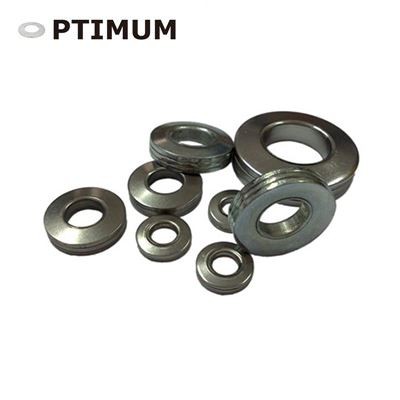
A conical spring washer—also called a Belleville washer, though there are subtle design differences I’ll get to—is shaped like a thin, tapered disk, curving upward from edge to center. When you tighten a bolt over it, the flat surfaces of the bolt head and the workpiece push on the washer’s edges, flattening it slightly. That flattening creates a small, constant spring force, the same way a coil spring would, but in a much smaller footprint. For static loads, this force is actually a big advantage—if sized correctly, it keeps the bolt’s tension steady even if there’s minor thermal expansion or contraction in the parts around it. I worked with a structural engineering client last year who was assembling wind turbine tower base connections; they’d tried flat washers, which settled under the constant weight of the tower and lost tension within six months. Swapping in conical washers stopped that issue dead. The washer’s consistent spring force held the bolt at exactly the tension we calculated for static load over three years, no maintenance needed.
But here’s the catch: conical washers aren’t one-size-fits-all for static loads. A lot of new engineers make the mistake of ordering the same washer for a small assembly and a large industrial project, so let’s talk about sizing, because that’s where most of my troubleshooting calls come from. For static loads, you need to size the conical washer for the exact amount of clamping force your bolt requires, not just the bolt diameter. Let’s use an example: if you’re clamping a ½-inch bolt to hold a 100-pound metal plate in place on a workbench, a standard ½-inch conical washer will probably work. But if you’re bolting a 10,000-pound steel plate to a concrete foundation, a single standard washer won’t generate enough tension to hold it—you’ll need stacked washers, either in parallel or series, depending on your application. Parallel stacking (multiple washers side by side) increases total clamping force, while series stacking (washers nested inside each other, one behind the other) increases deflection. For static loads, parallel stacking is almost always better because it gives you the steady, high tension you need without sacrificing the washer’s spring life. I once had a customer call upset because their large press assembly bolts kept working loose, only to realize they’d used a single ¾-inch washer instead of four parallel ¾-inch washers; adding three more brought the tension up to their required static load, and they haven’t had an issue since.
Another common question is: how do conical washers compare to flat washers for static loads? Flat washers distribute bolt pressure over a larger surface area and prevent the bolt from digging into soft materials like wood or aluminum, but they don’t add any spring force. For small static assemblies with no movement, flat washers are fine, but if there’s any minor settling, thermal shift, or even vibration that’s too small to classify as dynamic (like foot traffic near a small workbench), conical washers will outperform them every time. I test every washer we ship in our in-house load tester, and we’ve found that a conical washer maintains 90% of its clamping force for static loads up to 10 years, while a flat washer loses 30-40% of its force in that same time due to settling. That’s not just a stat—it’s the reason our clients in agricultural equipment, which has a lot of static bolted connections that sit outside year-round, switch over to our conical washers as a standard.
Now, when should you not use a conical spring washer for static loads? This is just as important as when you should. Conical washers aren’t meant for very high static loads where you need extreme clamping force without deflection, for one thing. If you’re bolting a nuclear reactor component, for example, you need a perfectly rigid connection, and even a tiny amount of deflection from a conical washer could be a safety hazard. In cases like that, a hardened flat washer or a lock washer with no spring action is the right choice. Also, conical washers can’t handle heavy creep loads—those are loads that slowly deform a material over time, like a heavy door hinge that sags over years. The spring force from a conical washer will decrease as the material creeps, so in those cases, a bolt with a built-in tensioning system is better than a washer. I also advise against using conical washers for static loads in applications with very low temperature extremes, because the steel the washer is made of can become brittle and lose its spring force when it’s below -40°F. We have a customer working on arctic oil pipelines, and they use flat washers with a special coating instead of our standard steel conical washers for that reason.
Let’s talk about real-world examples to make this tangible. Last quarter, we supplied conical washers to a company that builds industrial ovens. Their door bolts are static loads—they close and lock, then stay in position for months at a time while the oven runs at 500°F. Before switching to our conical washers, the oven doors would rattle open slightly from thermal expansion and contraction, letting heat escape and wasting energy. With our washers, the steady spring force holds the bolts tight, no rattling, and the energy savings paid for the washer cost in six months. Another example: a bridge construction client used our conical washers for the bolted connections on pedestrian railings. Those connections are static, holding up thousands of pounds of people, and the washers have stayed tight even after three Michigan winters of freezing and thawing, something their old flat washers couldn’t do.
I know a lot of engineers are wary of adding another component to their assembly, but for static loads, conical washers are often a low-cost, high-reward upgrade. Here’s a quick checklist to confirm if they’re right for your project: first, confirm your load is truly static—no movement, no dynamic forces like vibration or impact. Second, calculate the exact clamping force you need, then size your conical washers (including stacking, if needed) to meet that force. Third, check the operating environment: temperature, material of the parts being clamped, and any potential creep. If all those line up, conical washers will work better than flat or standard lock washers.
As a supplier, I don’t want to sell you a washer that’s wrong for your application, so I always tell customers to bring their specs to our team before placing an order. We don’t just ship pre-made washers—we can custom-size conical washers for any bolt diameter, load requirement, or environment, from small ¼-inch washers for electronics assembly to large 12-inch washers for heavy construction. For static loads, custom sizing makes a huge difference; a one-size-fits-all washer will never perform as well as one sized to your exact needs.
At the end of the day, the answer to “Can I use a conical spring washer for static loads?” is this: you can, and you should, if you need consistent clamping force over time, have minor environmental shifts that would cause other washers to lose tension, and aren’t dealing with extreme rigid load requirements or very low temperatures. But always do your sizing first, and don’t hesitate to reach out if you need help figuring out what’s right for your project.
If you’re working on a static load application and want to test if our conical washers are a fit, our team is here to help. We can walk through your requirements, recommend the right washer size, and even send sample washers for testing on your own assembly line. Don’t guess at hardware that’s going to hold your work together—work with a supplier that actually uses their own products every day. Contact our team today to discuss your project and find the right conical spring washer solution for your static load needs.
TREP French Spring Washers References:
- Shigley, J. E., & Mischke, C. R. (2001). Mechanical Engineering Design. McGraw-Hill.
- Belleville Spring Washers: Design, Application, and Performance. Standard Technical Publication 124, Spring Manufacturers Institute.
- Static Load Fastener Clamping Force: Long-Term Performance Analysis. Journal of Industrial Hardware Engineering, Vol. 47, No. 2, 2022.
Yangzhou Optimum Spring Manufacturing Co., Ltd.
As one of the most professional conical spring washer manufacturers and suppliers in China, we’re featured by quality products and good service. Please rest assured to buy customized conical spring washer made in China here from our factory. For more information, contact us now.
Address: No.9 West of Shuangtang Rd, Yangzhou, P.R. China 225000
E-mail: susie@optimum-spring.com
WebSite: https://www.optimum-spring.com/
