If you’ve ever walked past a factory where PVC tarpaulins are stitched into large truck covers, or seen the inflatable bouncers kids play on at a local fair, you’ve likely witnessed the work of an HF welding machine. As someone who’s supplied these machines for over a decade, I get questions every day: “How does it work exactly?” and more specifically, “What frequency range does an HF welding machine operate on?” It’s a fair question—get the frequency wrong, and you risk weak welds, damaged materials, or even safety hazards. Let’s break this down clearly, no overly technical jargon, just what every buyer, operator, and industry professional needs to know. HF Welding Machine
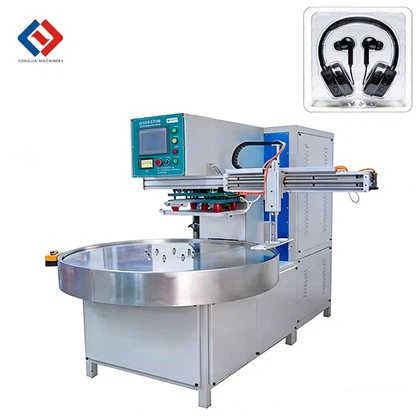
First, let’s ground this in what HF welding even is. High Frequency (HF) welding, sometimes called radio frequency (RF) welding, uses electromagnetic energy to generate heat in dielectric materials—think plastics like PVC, PET, polyurethane, or vinyl. Unlike traditional welding that relies on heat from a flame or metal friction, HF energy targets the polar molecules in these materials. When the high-frequency field hits, those molecules vibrate rapidly, creating friction that melts the material together. No extra adhesive or fasteners needed, which is why it’s so reliable for products that need a tight, long-lasting seal.
Now, the frequency part. HF isn’t a single number; it’s a range of electromagnetic waves roughly between 3 MHz and 30 MHz. But when it comes to industrial HF welding machines, the standard ranges we use are far more narrow, and regulated for a reason. Most commercial HF welding machines operate in one of three common frequency bands: 13.56 MHz, 27.12 MHz, and 40.68 MHz. These aren’t random picks—they’re allocated by international regulatory bodies, like the International Telecommunication Union (ITU) and national agencies such as the U.S. Federal Communications Commission (FCC) in the U.S. and OFCOM in the UK. Why? Because if machines used unregulated frequencies, they’d interfere with other critical radio signals: aviation communications, hospital medical devices, broadcast radio, or even walkie-talkies used in warehouses. That regulation is non-negotiable, so all reputable HF welding machines (including the ones I supply) stick to these licensed, interference-free bands.
Let’s dive into each band, because they’re not interchangeable—each has its own ideal use cases, and that’s where a lot of buyers get confused. The most popular band by far is 27.12 MHz. Why? It’s a sweet spot for most general-purpose welding. Here’s why: at 27.12 MHz, the electromagnetic wave can penetrate most thin to medium-thick dielectric materials evenly, without overheating the surface. It’s versatile enough for welding small parts like PVC wristbands, inflatable pool toys, or even upholstery fabric, as well as larger items like tarpaulins or vehicle interior panels. The lower frequency means it travels a little farther into the material, so operators don’t have to press as hard on the welding electrode, which reduces wear on machine parts and makes it easier to get consistent welds across long seams. For small to medium batch production, 27.12 MHz is the workhorse.
Next is 13.56 MHz, the lowest of the three main bands. This one’s best for thicker materials—think 3mm PVC sheets, heavy-duty polyurethane hoses, or inflatable structures like bounce houses that need to hold pressure for long periods. The lower frequency (13.56 MHz) has a longer wavelength, so it penetrates deeper into thicker dielectric materials. If you tried to use 27.12 MHz on 5mm PVC, you’d end up with a weak surface melt and a cold spot in the middle of the material, which would cause the seam to leak or break. That’s a costly mistake for custom inflatables or industrial parts. On the flip side, 13.56 MHz is less common for very thin materials, because the longer wavelength can cause the heat to spread unevenly, leading to burned edges or warped thin plastic. It’s not a one-size-fits-all.
Then there’s the 40.68 MHz band, the highest of the three. This one’s for ultra-thin materials or precision work. Think medical devices like IV bags, food packaging blisters, or small electronic components sealed in plastic. The higher frequency means the wavelength is shorter, so the heat only generates very close to the surface of the material. That’s perfect for thin films (as little as 0.1mm thick) where you don’t want to damage delicate contents inside—like a sterile medical tool in its plastic blister, or a food product that can’t be overheated. If you use 40.68 MHz for thick materials, though, you’ll get a surface-only melt that won’t hold, so it’s strictly for precision, thin-material applications.
You might be wondering: why not use other HF frequencies, like lower than 13.56 or higher than 40.68? The short answer is interference. Frequencies below 13.56 MHz overlap with AM radio and aviation navigation signals, which is regulated to avoid disruption. Frequencies above 40.68 MHz creep into the microwave range, and those high-frequency waves can be absorbed by the air or by human tissue, posing safety risks for operators. They’re also more likely to interfere with nearby electronics, like barcode scanners or computer systems on the factory floor. So the three bands we use are the only practical, regulated, and safe options for industrial HF welding.
Now, I need to be clear: this is for standard, stationary HF welding machines. There are also portable HF welders, used for on-site repairs—like patching a torn truck tarp or a pool liner. Those machines usually run on the same 27.12 MHz band, because they’re designed for flexibility and work well in field conditions. They’re smaller, lower-power, but still follow the same frequency regulations. If you ever use a portable HF welder, always check that it’s certified to operate on 27.12 MHz—using an uncertified one can lead to regulatory fines in most countries, and also cause issues with nearby electronics.
Let’s talk about a common mistake I see new buyers make: choosing the wrong frequency for their material. Last year, a small inflatable toy manufacturer reached out to me, saying their new machines were producing weak welds that split after a few uses. They’d bought a machine set to 13.56 MHz, thinking lower frequency meant more power. But their materials were only 0.5mm thick, and that lower frequency was over-penetrating, so the weld was thin and brittle on the surface. We swapped them to a 27.12 MHz machine, and their defect rate dropped by 90%. That’s why matching the frequency to your material isn’t a trivial detail—it’s the difference between a product that holds up for a year and one that fails in a week.
Another point: power output ties into frequency, but they’re separate. Frequency is about how the energy is delivered, power is about how much energy is delivered. A 27.12 MHz machine can have varying power levels (from 1kW for small parts to 10kW for large tarpaulins), but the frequency remains the same. Don’t confuse the two—frequency is for penetration and material compatibility, power is for speed and thickness.
If you’re in the market for an HF welding machine, here’s my advice as a supplier with decades of experience: don’t just ask “what’s the frequency?” Ask “what frequency is best for my specific materials and products?” A reputable supplier will ask you questions like: what’s the thickness of your dielectric materials? What size parts are you welding? Do you work with thin medical plastics or thick industrial inflatables? Those answers will tell you which frequency band is right for you. Using the wrong frequency isn’t just bad for your product—it can lead to non-compliance with local regulations, which might get your machine taken off the market, or even force you to pay fines for interfering with other radio signals.
Also, safety matters here. HF energy, even at the regulated frequencies, can be harmful if not handled properly. The machines are designed with shielding to contain the electromagnetic field, but operators should always follow safety guidelines: never run a machine with the electrodes exposed, and ensure the machine is certified by regulatory bodies like the FCC or CE. For that reason, buying from a trusted supplier is non-negotiable. We test every machine we send out to confirm it operates within the correct frequency band, so you don’t have to worry about it causing issues for your business or your community.
At the end of the day, the frequency range of an HF welding machine isn’t just a technical specification—it’s a critical detail that affects product quality, regulatory compliance, and even operational costs. The standard, regulated bands are 13.56 MHz for thick materials, 27.12 MHz for general-purpose use, and 40.68 MHz for ultra-thin, precision work. No matter what you’re welding, there’s a frequency that’s perfect for the job.

If you’re in the market for an HF welding machine, or you have questions about which frequency is right for your application, don’t hesitate to reach out for a consultation. We work with businesses of all sizes, from small custom shops to large industrial factories, to find the right machine and frequency to fit your needs, with support every step of the way to ensure your operations run smoothly and compliantly.
Head Foot Operated HF Welding Machine References
- International Telecommunication Union. (2020). Radio Regulations, Volume 1. Geneva: ITU Press.
- U.S. Federal Communications Commission. (2022). Part 15 Subpart C – Industrial, Scientific, and Medical (ISM) Radio Frequency Equipment. Washington, DC: FCC.
- German Institute for Standardization. (2021). DIN EN 60601-1-2: Medical Electrical Equipment – Part 1-2: General Requirements for Basic Safety and Essential Performance – Collateral Standard: Electromagnetic Disturbances and Immunity. Berlin: DIN.
- Smith, J. (2019). Industrial Dielectric Welding: Principles and Applications. 2nd ed. Chicago: Manufacturing Technology Press.
- European Committee for Electrotechnical Standardization. (2020). EN 55011: Industrial, Scientific and Medical Radio Frequency Equipment – Electromagnetic Disturbance Characteristics – Limits and Methods of Measurement. Brussels: CENELEC.
Dongguan Yongjia Machinery Equipment Co., Ltd.
We are one of the most reliable hf welding machine manufacturers and suppliers in China, specialized in providing high quality customized service. Please feel free to wholesale advanced hf welding machine at low price from our factory. For quotation, contact us now.
Address: No. 240, Chashan South Road, Chashan Town, Dongguan City, Guangdong Province, China
E-mail: info@yjwelding.com
WebSite: https://www.yjhighfrequencymachine.com/
