If you’ve ever stopped to think about the quiet workhorses keeping industrial pumps, compressors, and engine systems running smoothly, chances are you’ve never pictured a bimetal valve plate. But these unassuming components are critical to the performance, durability, and reliability of the machinery that powers manufacturing, agriculture, oil and gas, and countless other sectors. As a supplier with years of hands-on experience engineering, testing, and delivering bimetal valve plates to teams around the world, I’ve lost count of how many times customers have asked the same question: “What exactly is the shear strength of a bimetal valve plate, and why does it matter more than any other property when I’m choosing my components?” Bimetal Valve Plates
It’s a fair question. For anyone working in industrial maintenance, procurement, or engineering, specs like hardness, corrosion resistance, and wear resistance are easy to prioritize. Shear strength, though? It’s the silent guardrail that prevents catastrophic, unplanned downtime—costing businesses thousands of dollars in lost production, emergency repairs, and even safety risks. Let’s break this down, not from a textbook abstract, but from the perspective of someone who’s stood in our test lab, watched valve plates fail mid-cycle, and worked side-by-side with customers to get the shear strength right for their unique applications.
First, let’s make sure we’re all on the same page about what shear strength actually means in the context of a bimetal valve plate, not just a generic engineering term. Shear strength refers to a material’s ability to resist forces that push two adjacent parts of the material in opposite directions, parallel to the material’s plane. For a valve plate, these forces aren’t theoretical—they’re constant, brutal, and dynamic. Every time a valve opens or closes, it’s hit by high-velocity fluid flow, sudden pressure spikes, and repeated impact loads that generate shear stress across the plate’s surface and, crucially, across the interface between its two metal layers. That’s the key difference between a monometal (single-metal) valve plate and a bimetal one: the shear strength of the entire component isn’t just a function of the top layer, or the bottom layer, it’s a function of how well those two layers are bonded to each other.
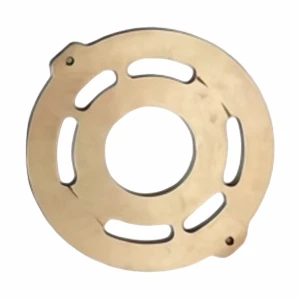
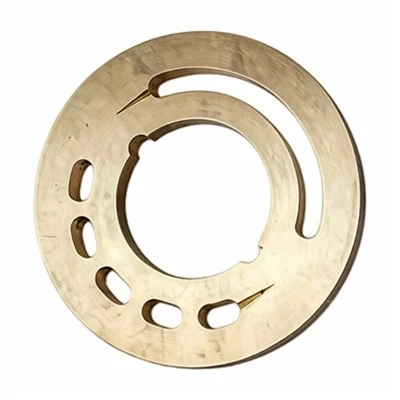
Our bimetal valve plates are made by bonding two distinct metal layers using a high-pressure, diffusion-bonding process that I’ve spent years refining with our team of metallurgists. The top layer—what comes into direct contact with the fluid being pumped, whether that’s corrosive chemical process water, abrasive slurries, or high-pressure natural gas—uses a corrosion-resistant or wear-resistant alloy, like 316L stainless steel or a hard-chromium-plated nickel alloy. The bottom layer is a tough, high-strength carbon steel or low-alloy steel, chosen for its structural rigidity and ability to mount seamlessly to the valve housing. The bond between these two layers is the critical juncture where shear failure most often occurs, and it’s why we don’t cut corners on bonding quality.
I remember a customer call two years ago from a food processing plant that was having major issues with their pump valve plates. They were using standard monometal 316L plates, but after just six weeks of use, the plates were delaminating—their top corrosion layer was peeling away from the base steel, rendering the valve useless and contaminating their product lines. When they tested our bimetal plates, their biggest concern was that the shear strength of the bond would hold up under the high cyclic loads their pumps faced. We ran our own tests for them, in our in-house lab, where we simulate 10 million open/close cycles to replicate real-world wear and stress. The test results showed that the shear strength of our bond was 45 MPa (megapascals) at room temperature, and even at 120°C, their operating temperature, it held steady at 42 MPa. The customer went on to use our plates for over 18 months without a single delamination issue, saving them tens of thousands in downtime and replacement costs. That story stuck with me, because it’s exactly why shear strength isn’t just a spec number—it’s a solution to real, costly problems.
Now, let’s talk about what factors actually influence the shear strength of a bimetal valve plate, because it’s not a one-size-fits-all number. First, and most importantly, is the quality of the bonding process. As I mentioned, diffusion bonding is the gold standard here, but not all diffusion bonds are created equal. If you rush the bonding process, or don’t properly prepare the surface of the two metal layers to remove contaminants, oxides, or mill scale, the bond will be weak, with a shear strength far lower than it could be. We spend 72 hours on average preparing each pair of layers, using plasma cleaning and precise surface profiling, before applying pressure at 1,100°C to fuse the atoms of the two layers together. This isn’t a quick process, but it’s what gives our plates consistent, reliable shear strength across every unit we ship.
Next, the properties of the two individual metal layers play a role too. The shear strength of the top and bottom layers themselves has to be matched to the bond’s strength, otherwise you’ll see failure in one of the base layers before the bond lets go. For example, if you pair a high-strength carbon steel base with a thin, soft top layer of aluminum, the metal layers will shear before the bond does—but that soft top layer will wear out in days. We work with customers to select layer materials that complement each other: if their application is an abrasive slurry pump, we pair a wear-resistant Stellite 6 top layer with a high-tensile AISI 4140 steel base, creating a bimetal plate where the bond is the strongest part of the component, not the weak link.
Application conditions are another huge factor. A valve plate operating in a chemical processing plant with pH levels of 2 will need a different shear strength rating than a plate operating in a low-pressure HVAC pump, and both will be different from a plate in a high-voltage power plant’s cooling system, which faces constant pressure spikes and temperature swings up to 300°C. Shear strength isn’t a static number—we test each plate’s shear strength under dynamic conditions that match the customer’s exact use case, not just a standard room-temperature test. We also conduct post-test analysis of every failed plate (even the ones that pass) to refine our processes and ensure that we’re delivering shear strength that’s tailored, not generic.
A common misconception we run into is that higher shear strength is always better. That’s not true. If you specify a shear strength that’s far higher than what your application actually needs, you’re wasting money on over-engineered components that cost more than necessary, without any added benefit. For example, a customer recently came to us looking for bimetal valve plates for a small irrigation pump, and they asked for our highest-shear-strength plates, rated at 60 MPa. When we looked at their pump’s specs, we calculated that their maximum shear load was just 18 MPa—so a plate rated at 25 MPa would have been more than enough, cutting their per-plate cost by 30%. We walked them through the tradeoffs, and they went with the appropriately rated plates, which have now been running for over two years without issue. That’s the kind of partnership we pride ourselves on: not just selling the highest-spec part, but the right part for the job.
So, what does a typical shear strength rating for a quality bimetal valve plate actually look like? Most standard industrial bimetal valve plates have a bond shear strength ranging from 35 MPa to 55 MPa at operating temperatures up to 200°C, with high-temperature grades for power and oil and gas applications reaching up to 65 MPa at 300°C. But these numbers only matter if they’re tested under real-world conditions, not just in a lab. We third-party audit every batch of our valve plates to verify shear strength, sending samples to independent metallurgical testing labs to ensure our numbers are accurate, not inflated.
Over the years, I’ve seen firsthand how poor shear strength in valve plates leads to avoidable downtime. I’ve talked to maintenance managers who’ve had to shut down a $2 million production line for 72 hours because a valve plate delaminated mid-shift, costing them more in lost revenue than they spent on replacement parts for the entire year. I’ve worked with plant engineers who upgraded their bimetal valve plates just by switching to a supplier that prioritized bond shear strength, and cut their annual valve replacement costs by 40%. All of that comes back to one core point: shear strength is not a secondary spec for bimetal valve plates—it’s the primary spec that determines how long your components will last, how reliable your machinery will be, and how much money you’ll save in the long run.
As a bimetal valve plate supplier, our job isn’t just to ship parts—it’s to make sure those parts work for you, no matter what your application throws at them. We don’t just have a one-size-fits-all shear strength number; we work with you to analyze your pump, your process, your operating conditions, and recommend a bimetal valve plate with the exact shear strength you need, no more, no less. Whether you’re dealing with abrasive slurries, corrosive chemicals, high-pressure cycles, or extreme temperatures, our team can engineer a plate that delivers consistent, reliable shear strength, so you can focus on running your business, not fixing unexpected valve failures.
If you’re tired of dealing with valve plates that wear out too fast, delaminate, or underperform, we’d love to talk. We can share our lab test data, walk you through our bonding process, or even send you sample plates to test in your own application. Contact us to discuss your bimetal valve plate needs.
Bimetal Strips & Sheets References
- ASME B106.1M-1985, Measurement of Shear Strength of Metallic Materials
- Materials Science and Engineering: An Introduction, Callister, W.D.
- Hydraulic Valve Component Design and Performance, CRC Press, 2018
- Diffusion Bonding of Bimetallic Components for Industrial Applications, Journal of Materials Processing Technology, 2020
Qingzhou Baiyun Anti-friction Products Co., Ltd.
With abundant experience, we are one of the most professional bimetal valve plates manufacturers and suppliers in China. Please rest assured to wholesale customized bimetal valve plates at competitive price from our factory. Welcome to contact us for quotation.
Address: Linglongshan North Road (south of the railway bridge), Economic Development Zone, Qingzhou City, Weifang City, Shandong Province
E-mail: byantifriction@gmail.com
WebSite: https://www.baiyunbimetal.com/
